History of Sadiki College
Founded in 1875 on the initiative of Grand Vizier Khaireddine Pasha, Sadiki College (Collège Sadiki) was the first modern secondary school in Tunisia. This page traces its history from published scholarship, cites its sources, and flags the points on which they disagree.
Contents
- Founded
- Decree of 13 January 1875; opening declaration of 1 February 1875
- Founder
- Khaireddine Pasha (Khayr al-Din al-Tunisi), Grand Vizier to Sadok Bey
- First director
- Mohamed Larbi Zarrouk (1875–1881)
- First premises
- Sidi El Morjani barracks, Rue Jamaâ Ezzitouna, Medina of Tunis
- Current site
- Kasbah hill, Tunis — building inaugurated in 1897 or 1901, depending on the source
- Heritage status
- Listed monument (1992)
1867–1874
1. A reformist project
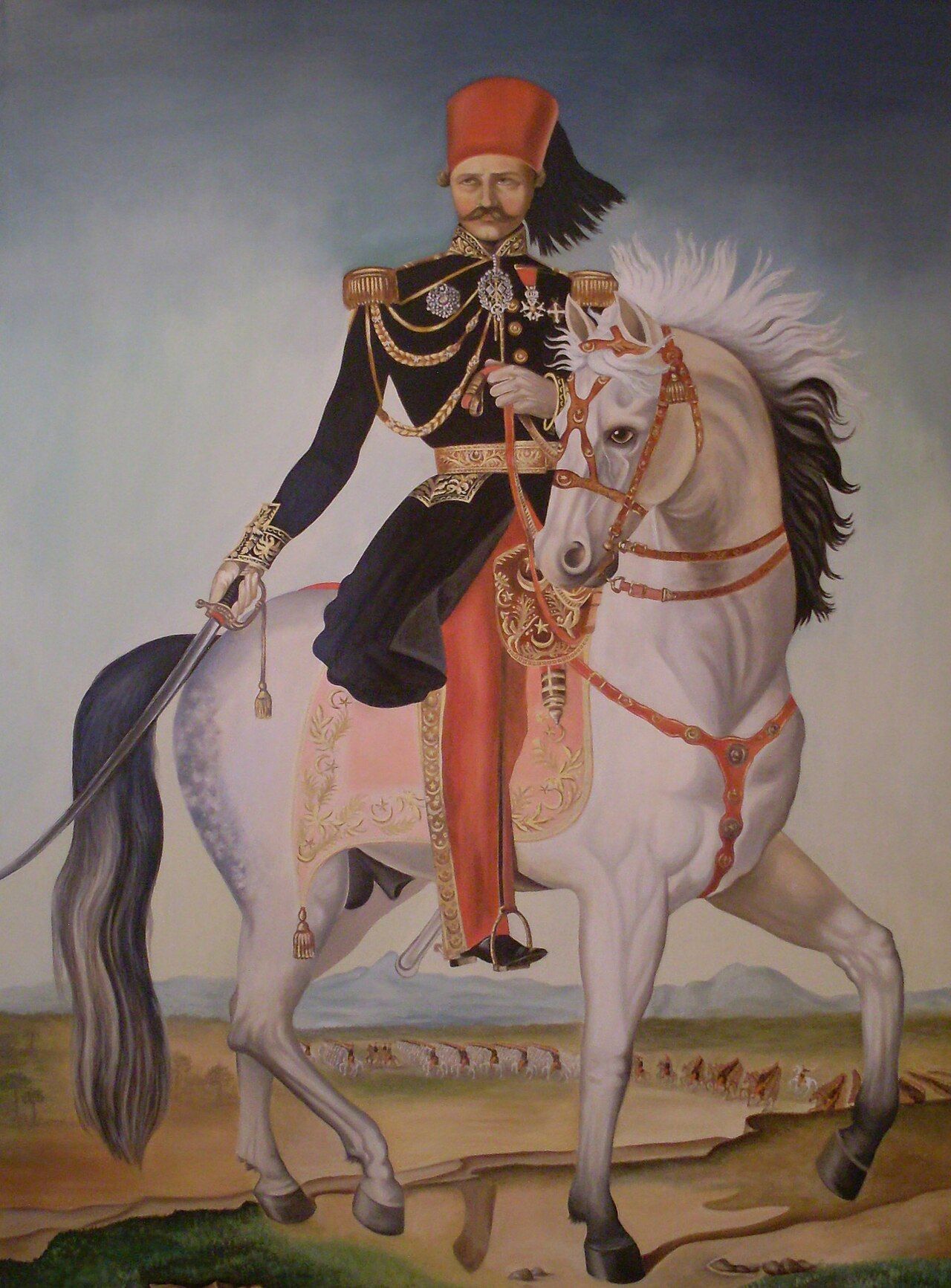
In 1867 Khaireddine Pasha set out his reform programme in Aqwam al-masālik fī maʿrifat aḥwāl al-mamālik ("The Surest Path to Knowledge of the Condition of Nations"). As Grand Vizier to Muhammad Sadok Bey, he made education one of the levers for modernising the state. [5]
The preamble to the founding decree justified the college by the Muslim community’s need for sciences useful in managing its affairs. The aim was not to replace the teaching of the Zaytuna, but to add modern disciplines alongside it. [1]
1875
2. The foundation
The college was created by an organic decree dated 13 January 1875 (5 Dhu al-Hijjah 1291), consisting of a preamble and 82 articles. Noureddine Sraïeb places its actual opening on 27 February 1875 (20 Muharram 1292). [1]
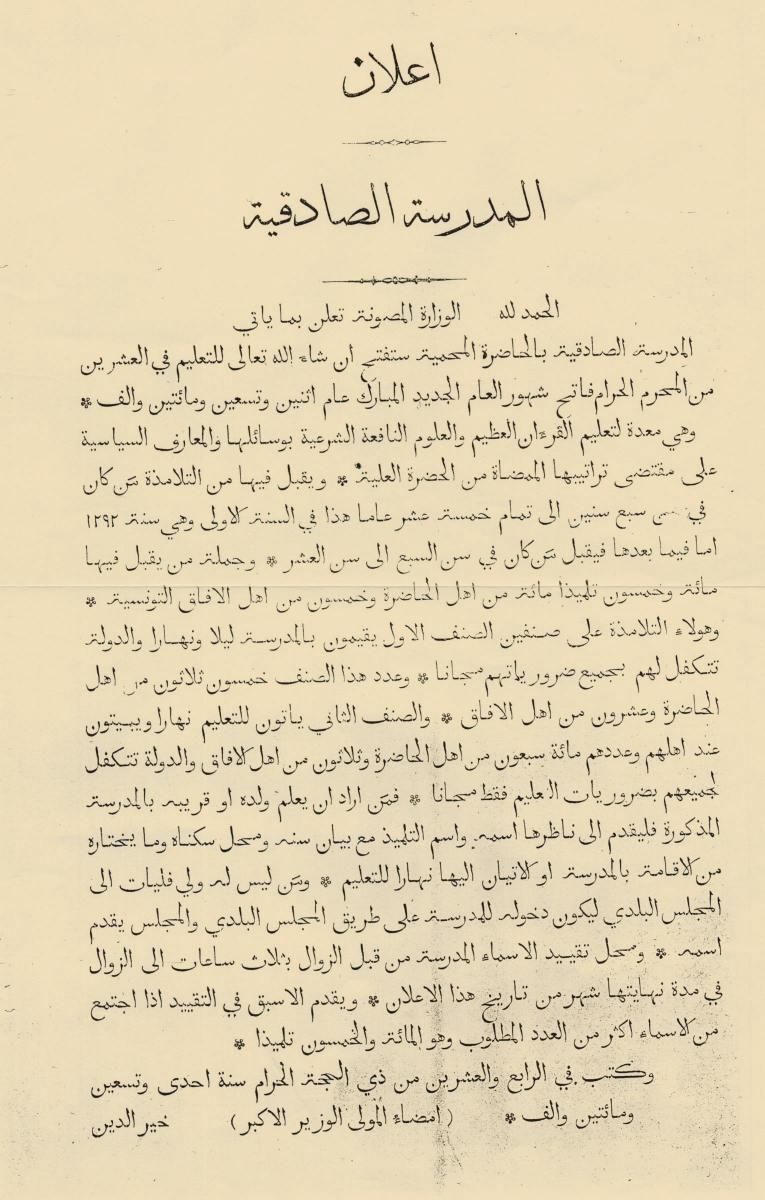
The surviving opening declaration, signed by Khaireddine, is dated 1 February 1875 (24 Dhu al-Hijjah 1291). The name "Sadiki" honours the reigning ruler, Muhammad Sadok Bey. [7]
To secure its financial independence, Khaireddine endowed the college, as habous (religious endowment), with the property confiscated from the former minister Mustapha Khaznadar. Tuition was free. [1][4]
The first intake numbered 150 pupils: 100 day pupils and 50 boarders according to Noureddine Sraïeb; 150 pupils including thirty boarders according to Ridha Kéfi. Pupils came from notable families as well as from the households of merchants, minor officials and workers. [1][4]
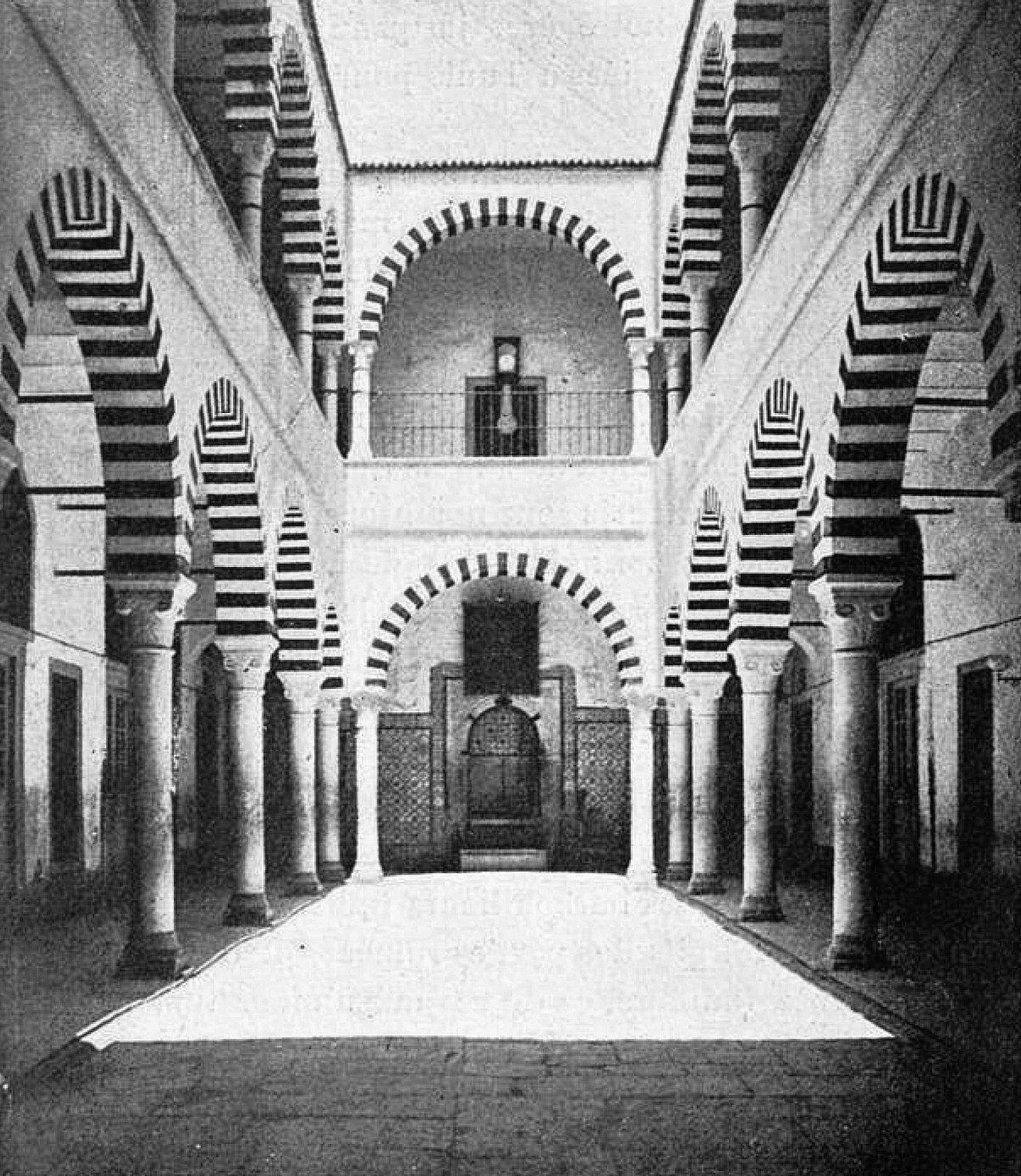
The college occupied the former Sidi El Morjani barracks, built by Hammouda Pasha in the early nineteenth century, on Rue Jamaâ Ezzitouna (formerly Rue de l’Église). Its first director was Mohamed Larbi Zarrouk (1875–1881). [1][4]
1875–1881
3. A new kind of education
The decree organised teaching into three sections: two devoted to Islamic law and the Arabic language, and a third to foreign languages — Turkish, Italian and French — and to practical sciences: mathematics, natural sciences, medicine, agriculture and chemistry. [1]
The teaching staff combined Zaytuna scholars with foreign teachers. Of the 66 pupils from 1875–1885 whose careers are known, 33.5% became secretaries or interpreters, 24% went into commerce or managed their property, 23% became teachers and 7.5% entered government service. [1]
1881–1956
4. Under the French protectorate
After the protectorate was established in 1881, decrees of November 1882 and January 1886 reorganised the college, which came under the Directorate of Public Instruction created on 6 May 1883 and headed by Louis Machuel. Training was reoriented towards the needs of the administration. [1]
Italian and Turkish were dropped from the curriculum in favour of French alone, which Noureddine Sraïeb reads as an effort to extend French influence over Tunisian elites. The college supplied the administration with bilingual officials while remaining under close watch. [2]
Under Marius Delmas (1892–1912) teaching was refocused on Arabic–French bilingualism for administrative careers. From 1927 Gabriel Mérat increased enrolment, opened boarding to fee-paying pupils and strengthened the sciences. Mohamed Attia, appointed in 1944, was the first Tunisian to head the college since 1892. [1][11]
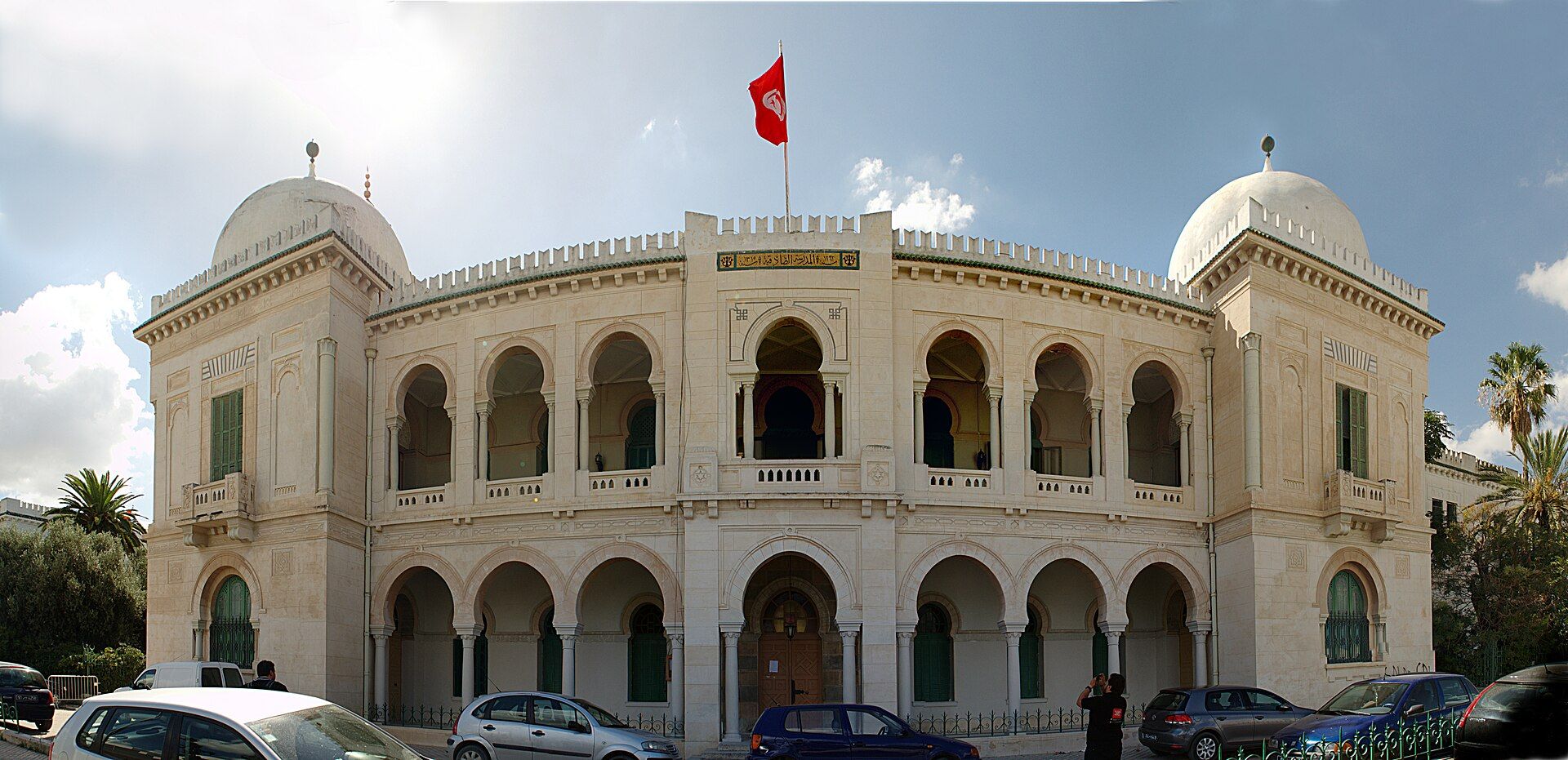
At the end of the nineteenth century the college left the medina for a building erected by the protectorate authorities on the heights of the Kasbah. Designed by the French architect Maillet, it combines the solemnity of French official buildings with the forms of traditional Arab architecture. Sources disagree on its inauguration date: 1901 according to Ridha Kéfi, 1897 according to the historian Abdelhamid Larguèche. [4][5]
The building overlooks the Kasbah Mosque, the Aziza Othmana hospital and the government square; its main entrance faces Boulevard Bab Bnet. [4]
"The spread of secondary education could give our Tunisian protégés ideas ill-suited to the state of political subjection in which they find themselves."
1896–1956
5. A nursery of the national movement
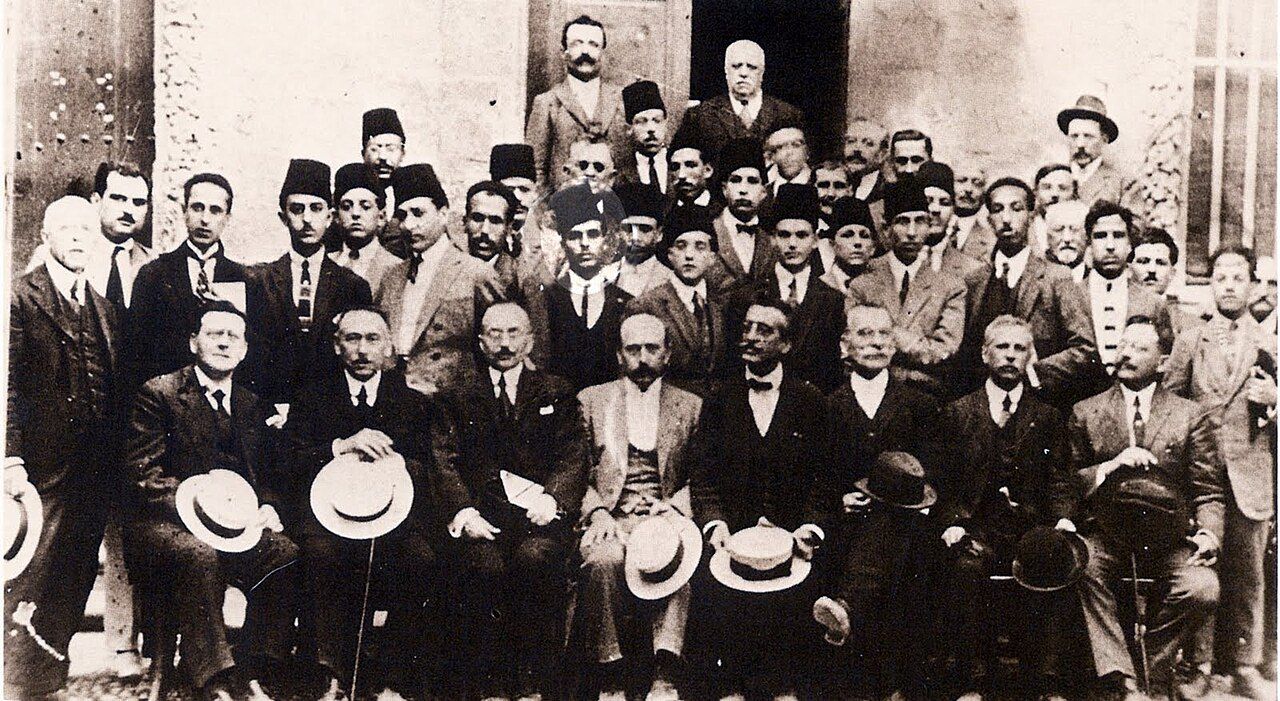
Former pupils were at the heart of early twentieth-century reformism. Béchir Sfar founded the Khaldounia in 1896. Ali Bach Hamba founded the Sadiki Alumni Association in 1905 and in 1907 launched the newspaper Le Tunisien, the organ of the Young Tunisians movement. [5]
On 9 April 1938 Ali Belhouane, a teacher at the college, mobilised pupils during the demonstrations calling for a Tunisian parliament. [5]
According to Noureddine Sraïeb, Sadiki alumni made up 60% of the Neo-Destour political bureau (92 people) between 1955 and 1969. The academic Lazhar Sakhraoui estimates that 55% of the statesmen of the post-independence era were products of Sadiki education. [2][6]
"From independence to today, five presidents have governed Tunisia, four of them Sadikians," Chedly Ben Younes noted in 2016. Habib Bourguiba, Fouad Mebazaa, Moncef Marzouki and Béji Caïd Essebsi are indeed alumni, as is Kaïs Saïed, President of the Republic since 2019. [6][11]
1956 to the present
6. Since independence
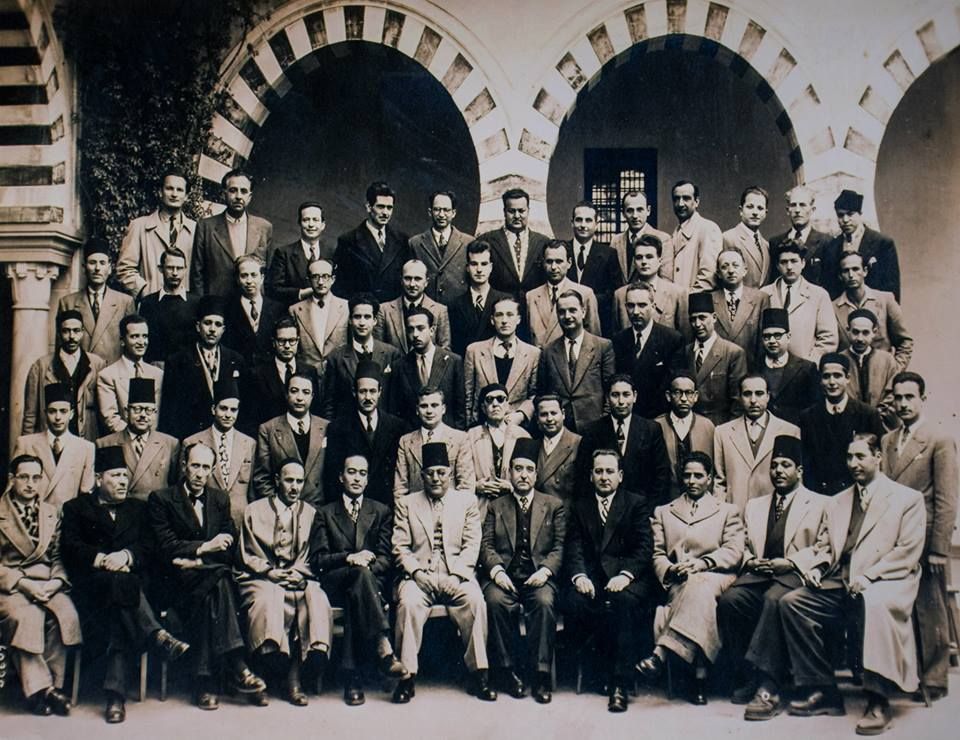
On 25 June 1958 President Habib Bourguiba gave a speech at the college announcing that all secondary-school subjects would eventually be taught in Arabic throughout the country. [8]
Teachers from France continued to work there until the 1970s, and teaching was given in both Arabic and French. [4]
The building was listed as a monument in 1992. After the 2011 revolution it was chosen to appear on the new twenty-dinar banknote. [5][10]
In 2025 the college marked the 150th anniversary of its foundation, including with a photographic exhibition opened on 20 February 2025. [5]
على الهضاب، على الهضاب، وسط روض بديع، تبدو القباب، والمنار الرفيع
"On the hills, on the hills, amid a splendid garden, the domes appear, and the lofty minaret."
Timeline
-
1867
Khaireddine publishes his reform programme, Aqwam al-masālik.
-
13 January 1875
Organic decree creating the college (82 articles).
-
1 February 1875
Date of the opening declaration signed by Khaireddine.
-
27 February 1875
Actual opening, according to Noureddine Sraïeb.
-
1881
French protectorate established.
-
6 May 1883
Directorate of Public Instruction created (Louis Machuel).
-
1896
Béchir Sfar founds the Khaldounia.
-
1897 or 1901
Kasbah building inaugurated (sources differ).
-
1905
Sadiki Alumni Association founded.
-
9 April 1938
Ali Belhouane mobilises pupils for a Tunisian parliament.
-
1944
Mohamed Attia becomes director.
-
25 June 1958
Bourguiba’s speech on the Arabisation of secondary education.
-
1992
Building listed as a monument.
-
2025
150th anniversary of the foundation.
Directors and headmasters (1875–1970)
| 1875–1881 | Mohamed Larbi Zarrouk |
| 1881–1888 | Hsouna Mtali, Omar Baraket, Mohamed Karoui, Aroussi Ben Ayed |
| 1888–1892 | Tahar Ben Salah |
| 1892–1912 | Marius Delmas |
| 1912–1927 | Pierre Bollon |
| 1927–1934 | Gabriel Mérat |
| 1934–1941 | Jean Lecomte |
| 1944–1955 | Mohamed Attia |
| 1955–1968 | Abdelwahab Bakir |
| 1968–1970 | Mohamed Habib Zghonda |
List compiled from Wikipedia. For Gabriel Mérat, Noureddine Sraïeb gives 1927–1938. The directorship from 1941 to 1944 is not reliably documented.[11]
Sources and bibliography
Bracketed numbers in the text refer to this list.
- [1] Noureddine Sraïeb, « Le collège Sadiki : histoire d’une institution », in La Tunisie mosaïque, Toulouse, Presses universitaires du Midi. books.openedition.org
- [2] Noureddine Sraïeb, Le Collège Sadiki de Tunis, 1875-1956 : enseignement et nationalisme, Paris, CNRS Éditions, 1995.
- [3] Noureddine Sraïeb, « Le collège Sadiki de Tunis et les nouvelles élites », Revue du monde musulman et de la Méditerranée, n° 72, 1994, p. 37-52. persee.fr
- [4] Ridha Kéfi, « Essadkia. Le collège Sadiki », Saisons tunisiennes, 18 janvier 2007. web.archive.org
- [5] Abdelhamid Larguèche, « Depuis un siècle et demi, le collège Sadiki au fondement de la modernité tunisienne », Kapitalis, 17 février 2025. kapitalis.com
- [6] « الصادقية التونسية.. أيقونة العلم والنضال ورجالات الدولة », Anadolu Agency (édition arabe), 11 avril 2016. aa.com.tr
- [7] Déclaration d’ouverture du collège Sadiki, 1er février 1875 (24 dhou al-hijja 1291), document original reproduit sur Wikimedia Commons. commons.wikimedia.org
- [8] Mohamed Daoud, « Arabization in Tunisia: The Tug of War », Issues in Applied Linguistics, vol. 2, n° 1, 1991. escholarship.org
- [9] Khaled Guezmir, Jeunes Tunisiens, Tunis, Alif, 1986.
- [10] Thierry Brésillon, « De la modernité à l’identité : le sens des nouveaux billets de banque tunisiens », Rue89, 12 novembre 2011.
- [11] Wikipédia, « Collège Sadiki » (liste des proviseurs) et catégorie « Élève du Collège Sadiki », consultées en septembre 2026. fr.wikipedia.org